
China has made serious inroads into Latin America, which the US may now be hinting is simply not ok: Stay in your lane, Xi! In simple terms, China will no longer have access to Venezuelan oil, points out Rajeev Srinivasan.

For India, much is at stake: Crucial energy supplies traversing the Strait of Hormuz, the fate of its 10 million citizens living and working in West Asia -- who send generous remittances home -- and its major trade links with the region.

Trump also called upon China, France, and Japan, among others, to send ships to the Strait of Hormuz.
India has emerged as the most impacted market within emerging economies, experiencing $3.7 billion in outflows over the past three weeks, matching the total outflows from the entire emerging market basket, as global equity funds turn negative for the first time since January 2026 due to escalating geopolitical tensions.

India should simultaneously prioritise domestic exploration and production of more oil and gas in the country, and ensure we retain diversified suppliers for imports, points out former foreign secretary Ranjan Mathai.

Ultra-personalisation is the new standard for Indian tourists.
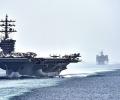
Which are the world's most vital straits, important to shipping?
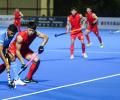
Hockey: India seek World Cup berth through Asia Cup triumph; up against China in opener

United States President Donald Trump on Wednesday announced his upcoming diplomatic trip to Malaysia, South Korea, and Japan, highlighting a significant meeting with Chinese President Xi Jinping in South Korea.

According to www.budgetyourtrip, Asia is home to some of the world's priciest travel destinations.

A Chinese diplomat's aggressive comments threatening the Japanese Prime Minister over remarks about Taiwan have ignited a diplomatic row between China and Japan.

'India needs at least 70,000 to 80,000 eyewear stores; our 2,000 stores are just a drop in the ocean.'

From TimeOut's latest global line-up of 39 hip, exciting localities, here are 6 standout Asian stars...

iPhone maker Apple hit an all-time revenue record in India during September quarter, marking a strong growth streak in the world's second largest smartphone market where the tech titan has been deepening retail footprint and local manufacturing.

Karex, the Malaysian company that makes roughly one in five of the world's condoms -- about five billion a year, supplying Durex and Trojan among others -- announced this week that it is raising prices by up to 30 percent. The reason is the Strait of Hormuz.

'It was diminishing even before Trump came to power.' 'The US was at the centre of the global economy. That position is going to become less and less important and less central.'

The 'rescue' operation occurred within kilometres of Iran's underground tunnel complex at Isfahan, assessed by the IAEA and US intelligence as holding a substantial portion of the country's 60 per cent enriched uranium stockpile. Retired senior US military officers have highlighted that the mission's footprint -- hundreds of special operators, multiple heavy-lift aircraft deep inside Iran -- appears outsized for recovering a single airman. Prem Panicker continues his must read blog on the Iran War.

The cost of the war is being counted not in the corridors of power in Washington or Tehran, but in Firozabad's darkened furnace rooms, Howrah's idle casting sheds, and a barbershop in Kochi where the wait is suddenly, inexplicably, an hour long, notes Prem Panicker in his must read blog on the Iran War.
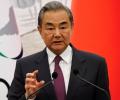
China on Tuesday called for a 'comprehensive and lasting ceasefire' between India and Pakistan, urging both countries to properly handle their differences through dialogue.

Following the BNP's victory in recent elections, Bangladesh is seeking to reset its relationship with India, emphasizing mutual benefit and a recognition of the changed political landscape.

Malaysia came from a goal down to crush lower-ranked Bangladesh 4-1 before title holders Korea thrashed Chinese Taipei 7-0 in Pool B matches of the men's Asia Cup hockey tournament

Bangladesh is likely to replace Pakistan in the men's Asia Cup hockey tournament to be held in Rajgir, Bihar from August 29 if the latter fails to confirm participation in the next couple of days.
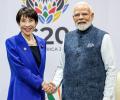
If they act now, they can reshape the strategic map of Asia without firing a shot. If they wait, the next opportunity will come only after a serious Taiwan Strait incident -- by which time the price will be far higher, and the room for boldness far smaller -- the opportunity may well be lost by then. The question is no longer whether this can or should be done, points out Varun Arya.

Will rising tensions between US-Israel and Iran threaten crude oil supply through the Strait of Hormuz, putting India's fuel prices, imports, and economic stability at risk?

India should resist knee-jerk responses to tariff volatility in the US and instead use the current geopolitical churn to build manufacturing scale at home, former G20 Sherpa and former chief executive officer of NITI Aayog Amitabh Kant said on Wednesday.

The 2025 US National Security Strategy marks a major pullback, with America turning backward and effectively allowing China greater dominance in Asia. while long-time partners like India are left to face an increasingly unstable global order largely on their own, observes Rajeev Srinivasan.

In the Indo-Pacific's new era -- where perception shapes reality faster than treaties -- the real entrapment is not of China or the United States. It is the test Japan has set for itself -- and whether partners like India, acting as balancers rather than accelerants, can help ensure that the story ends in stability, points out Varun Arya.

India emerged from the war militarily bruised and strategically altered. The United States, under the guise of friendship, had succeeded in achieving what open alignment never could: The psychological and political repositioning of India within the Cold War order, points out Dr Kumar.

The delegations from the US and Iran head to Islamabad on Friday, carrying a ceasefire that is already fraying, a Strait that is technically open and practically closed, and a negotiating agenda that would challenge even parties actually negotiating in good faith, which these groups are not. Prem Panicker continues his must read blog on the Iran War.

In several parts of the world, access to proper sanitation remains a serious challenge. Many communities still lack household toilets or safe waste disposal systems, often due to water shortages, economic hardship or limited infrastructure.

'TTP has vowed to take revenge for the attacks that Pakistan is carrying out against Afghanistan.' 'To diminish this threat, Pakistan is hitting Afghanistan hard.'

'If China shows greater concerns for Indian interests, ties could improve. Otherwise, the thaw could be short-lived.'

United States President Donald Trump has said that Iran is under close watch and a 'massive fleet' is heading towards the Gulf region.

India are confident of reclaiming the men's Asia Cup hockey title after a hiatus of eight years and qualify for next year's World Cup

'Was the five-day pause ever meant to hold, or was it simply another instrument of signaling, of positioning, of buying time in a war where even the pauses are tactical?' asks Prem Panicker in his must read daily blog on the Gulf War.

This weekend, Donald Trump has begun to say the quiet part out loud -- that he wants to take control of Iran's oil, a formulation more in line with his robber-baron style of international relations.

The top two teams from the Super 4s will progress to the summit clash, and a draw would be enough for India to seal their place in Sunday's final.

Hosts India maintained their unbeaten run with a hard-fought 2-2 draw against defending champions Korea in their opening Super 4 stage match of the Asia Cup in Rajgir, Bihar, on Wednesday.
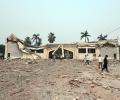
'Every decision India makes along the LoC, it must also consider implications along the LAC.'

Foreign tourist arrivals in India dropped to 6.18 million during the April-September 2025 period against 7.06 million during the same period last year, which was a drop of 12.4 per cent.
